
Calvert County Projected Release Dates
A judicial sentence sets the legal term. A Calvert County projected release date is a working date based on that term, its start, credit for time already served, sentence structure, and the credits or restrictions that law allows. A parole-eligibility date marks when a person may first be considered under the applicable rule. Mandatory-supervision release may occur when awarded diminution credits equal the time left. Maximum expiration is the end of the full term. None of these is automatically the actual gate time.
Actual release occurs when the facility carries out the controlling release authority and no other warrant, detainer, sentence, or transfer keeps the person in custody. A judge can order release before CCDC finishes processing. A parole decision can approve release before a home plan or administrative step is complete. One term can expire while another agency assumes custody. Those records describe different events and should not be collapsed into a single date.
- Projected release
- An official or estimated date based on the current sentence calculation.
- Parole eligibility
- The first possible consideration point under the applicable parole rule, not a release promise.
- Mandatory supervision
- Conditional release caused by awarded diminution credits under Maryland law.
- Maximum expiration
- The end of the sentence term before a separate hold or sentence is considered.
- Detainer
- A request or legal hold that can keep custody in place or cause transfer to another authority.
Find Calvert County Release Dates
First determine whether the person is awaiting trial, serving a local CCDC sentence, committed to the Maryland Division of Correction, or held in a federal system. Each authority owns a different record. A Calvert County arrest does not mean CCDC still holds the person, and a local transfer to the Commissioner of Correction is not release into the community.
- Match the person with a full legal name, date information if known, court case number, and booking or commitment identifier.
- Read the Calvert County court docket for the sentence, sentence start, time-served credit, concurrent or consecutive terms, later orders, and any probation or parole event.
- If the person is at CCDC on a local sentence, request the release-date calculation or final release entry from CCDC records. The Records Department, not an online calculator, is the authoritative local source.
- If the person is committed to Maryland DOC, use the state locator only to check current covered custody. Request the sentence-calculation, mandatory-release, maximum-expiration, or final release record from DPSCS.
- Check Maryland VINE for an agency-supplied release event or date. Record the agency and update time, and do not call that date a public locator calculation.
- Check for another case, warrant, detainer, parole condition, or transfer before treating the date as a community exit.
- After release, confirm the actual date and authority through the originating facility record, court order, or disclosable state record.
The Calvert County released inmate search helps identify the correct local, state, court, or federal channel before a date request is filed.
Note: Ask for an existing calculation or release record; Maryland public-record law does not require an agency to create a new forecast.
Calvert County Locator Date Limits
The Maryland DPSCS Incarcerated Individual Locator is a current-custody tool. It searches first and last name and can identify the facility for covered people in state custody. Its official explanation says people no longer in custody for any reason, including release or escape, are not listed. Released profiles do not remain available. A no-result response therefore cannot prove that a person was released.
Just as important, the public locator has no projected, anticipated, tentative, or mandatory release-date field. It should never be described as the place where a Calvert County state prisoner's projected date appears. The locator can establish a current covered location. An internal sentence-calculation record, VINE event supplied by an agency, court record, parole record, or final DPSCS release record must answer the date question.
The successful manifest image comes from the official DPSCS locator page and shows its public custody limits.
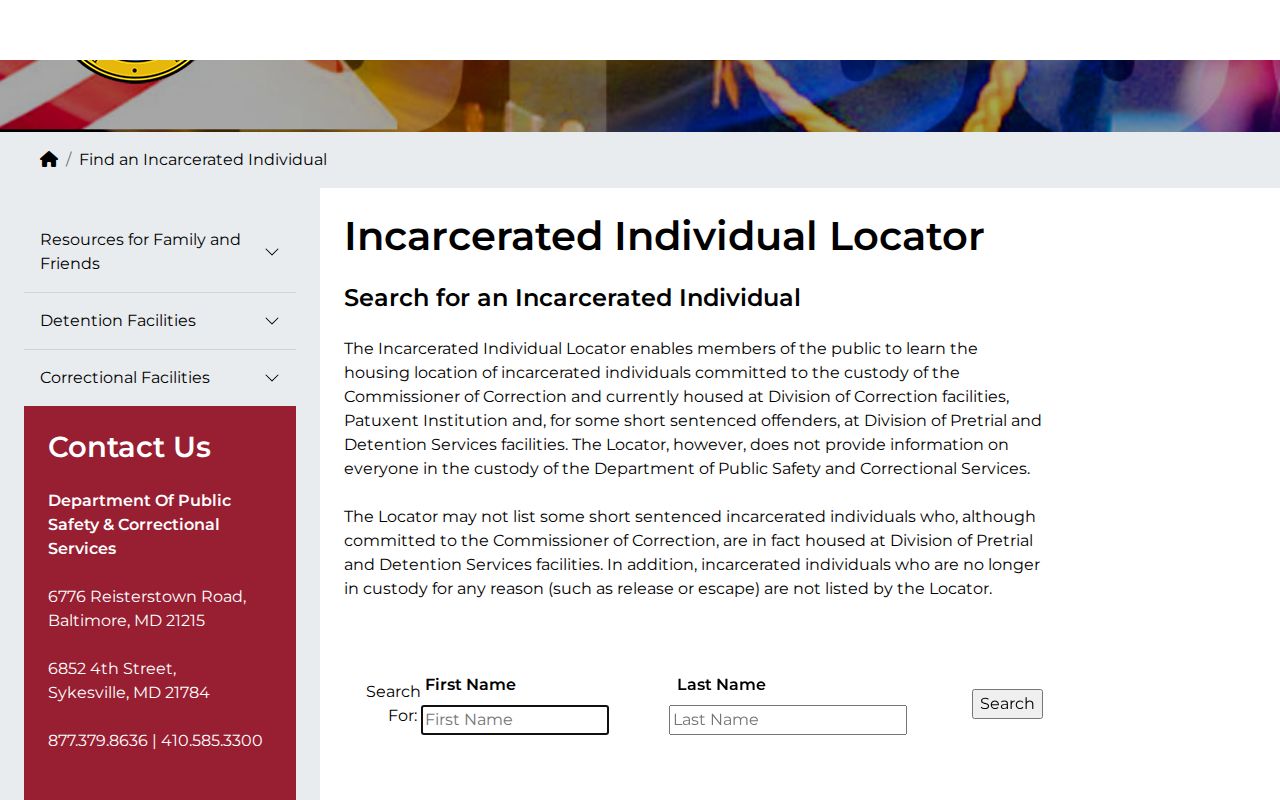
The official page confirms that the search is for current covered custody and does not retain a projected-date field or a released-person profile.
Calvert County State Release Credits
Calvert County state-prison calculations begin with the sentence and eligible credits. Correctional Services §3-702 establishes the diminution-credit entitlement for qualifying people committed to the Commissioner, subject to exclusions and other provisions. Section 3-704 governs good-conduct credit. Sections 3-705 through 3-707 cover work tasks, education, and special projects or programs. Section 3-708 limits combined credits and adds category restrictions.
Section 3-704 generally awards ten days per calendar month, prorated for a partial month. When the term includes a concurrent or consecutive sentence for a statutory crime of violence or specified drug offense, the good-conduct rate is five days per month. Other periods and offenses can affect eligibility. Additional credits are separate and depend on documented work, education, programs, eligibility, caps, and loss. No public estimate should assume that every category applies at its maximum.
The familiar “serve 85%” phrase is only shorthand. Five good-conduct days in a thirty-day month resembles about fifteen percent, but Maryland has no single universal rule requiring every Calvert County person to serve the same fraction. Offense classification, offense date, sentence date, concurrent or consecutive structure, exclusions, presentence credit, and revoked credits all matter. A shorthand charge label is not enough to classify the sentence.
The manifest's successful state good-conduct statute capture shows the controlling Maryland section.
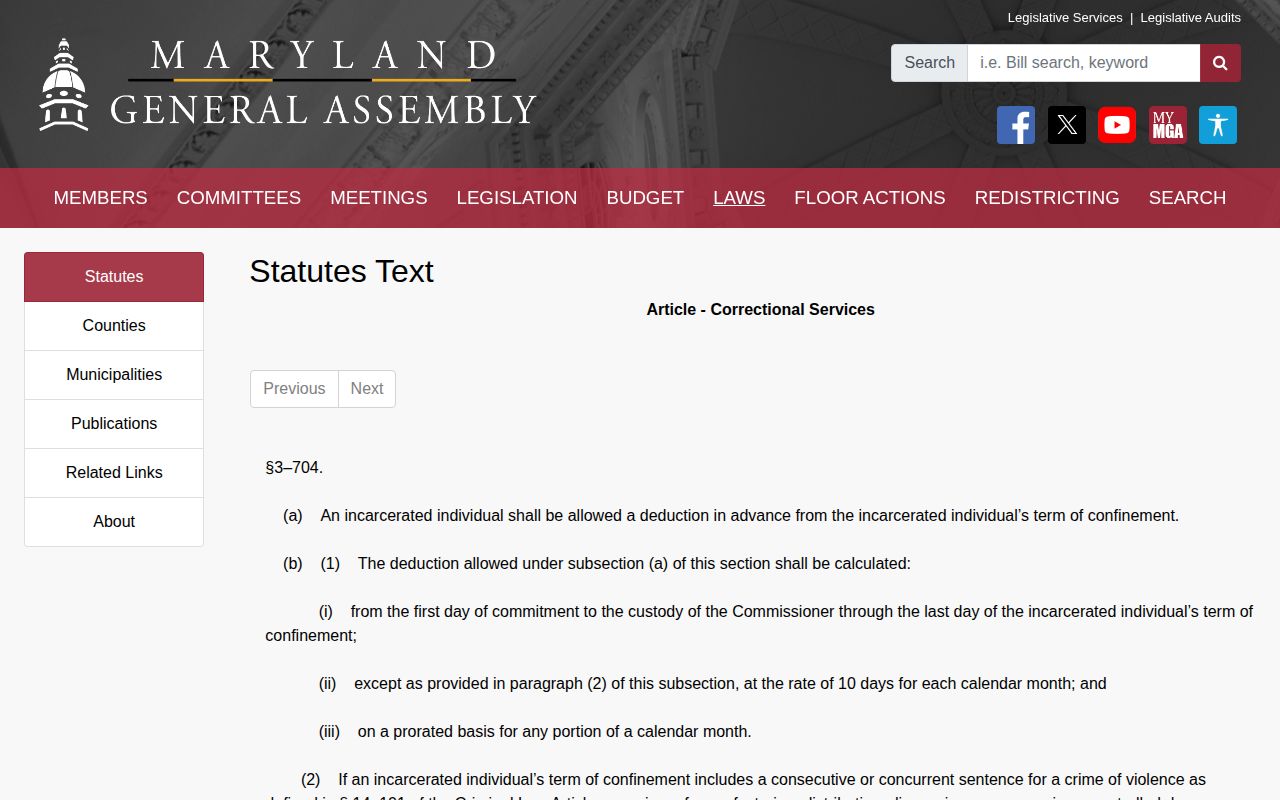
The statute demonstrates why a release date must come from the official calculation rather than a universal percentage.
Calvert County Jail Release Credits
Local CCDC sentences use a different statutory framework from state-prison sentences. Correctional Services §11-503 addresses presentence good-conduct credit. Section 11-504 covers postsentence good-conduct credit. Sections 11-505 and 11-506 address tasks and special work projects, while §11-507 permits revocation after due process. Mixing these local rules with the state DOC subtitle can produce the wrong date.
A careful Calvert County calculation starts with the judicial term and commencement date. It applies credit for time already served, checks whether terms run together or one after another, applies only credits that the record supports, and subtracts credits that were lawfully revoked. It then checks all other cases, warrants, detainers, and release conditions. CCDC's historical materials identify its Records Department as the office that computes release dates for sentenced inmates.
Pretrial detention is different. A person held before trial has no sentence-credit release date in the same sense. Release can turn on recognizance, bond, a judge's order, supervised pretrial release, case disposition, or a hold from another authority. Home detention or a community program can place someone outside secure detention while legal restrictions continue. The court order and CCDC record show the correct status.
The official local presentence credit capture in the manifest documents the separate Calvert County jail framework.
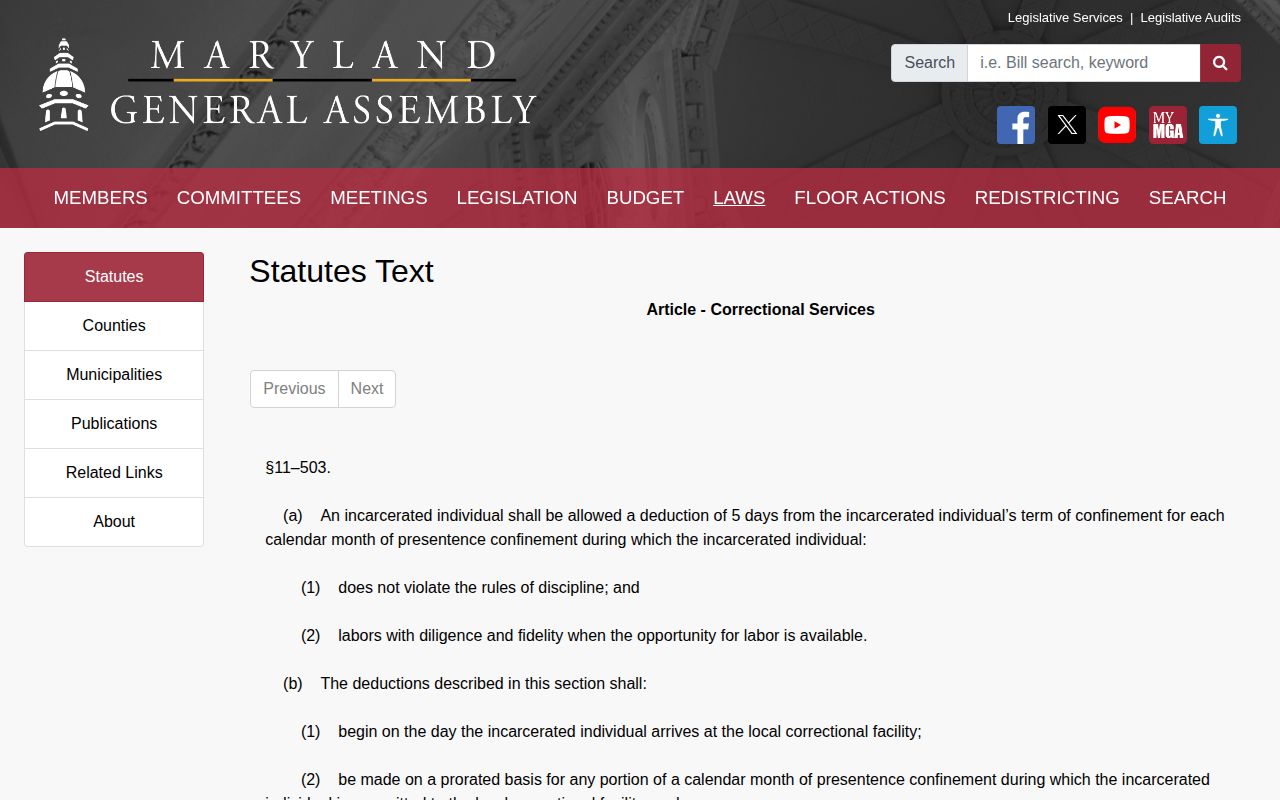
The local statute supports a CCDC records request instead of borrowing a state-prison formula.
Note: A transfer from CCDC to Maryland DOC ends the local booking but continues custody under a different calculation authority.
Calvert County Parole Release Dates
Calvert County parole eligibility is not a projected gate date. Correctional Services §7-301 contains eligibility rules that vary by offense, sentence, offense date, life term, and statutory exclusion. The baseline for many qualifying sentences of six months or more is one-fourth of the aggregate term. Crimes of violence and other categories can use more restrictive rules. Becoming eligible creates an opportunity for consideration, not a right to leave custody.
The Maryland Parole Commission may refuse parole, set a future rehearing, or approve parole. Approval can remain subject to an acceptable home plan and administrative processing. Misconduct, an unresolved detainer, an unmet condition, or another legal event can delay or change the actual exit. Treat the Commission decision date, an estimated release date, and the final gate event as three different facts.
Mandatory supervision under §7-501 is also conditional. For an eligible person serving more than eighteen months, awarded credits may equal the time remaining. Specified violent crimes committed on or after October 1, 2009 have additional timing restrictions, and written conditions generally apply. The word “mandatory” does not mean unconditional sentence discharge.
After an official source indicates parole or mandatory supervision, the Prince Frederick DPP Field Office is the local administration contact. The field office should be approached with the case or supervision identifier rather than treated as a public name-search system.
Note: Parole eligibility, approval, projected release, and the final gate event are separate dates that require separate records.
Calvert County Release-Date Changes
A Calvert County projected release date can change because its inputs and legal constraints change. The facility's current calculation should be preferred over personal arithmetic. When two official records show different times, identify what each record measures. A judicial order time and the later physical exit time can both be accurate.
| Factor | Effect on the date | Confirming record |
|---|---|---|
| Presentence credit | Proper credit for time already served can reduce the remaining term. | Sentencing sheet and official calculation |
| Concurrent or consecutive terms | Terms may overlap or run one after another. | Judgment, commitment, and calculation |
| Earned credits | Documented good-conduct, work, education, or program credits can move the estimate. | CCDC or DPSCS credit record |
| Credit revocation or restoration | A lawful loss can push the date back; a restoration can alter it again. | Disciplinary and sentence records |
| Court order or new sentence | A modification, violation result, or new term can change custody. | Signed court order |
| Warrant or detainer | One term may end while another authority keeps or assumes custody. | Facility release or transfer record |
| Parole decision and conditions | Eligibility, approval, and actual release occur at different stages. | Commission decision and final exit record |
Confirm Calvert County Actual Release
Maryland VINE may show a Calvert County date supplied by CCDC or DPSCS and can send a release alert. Register on the correctly matched record, compare the agency and identifiers, and save the timestamp. The date should be labeled as an agency-supplied VINE event, not as a projected field from the DPSCS public locator. The detailed registration route is available through the Calvert County VINELink inmate search.
For local custody, CCDC owns the actual release or transfer entry. Call 410-535-4300 for current operational information, then request the existing booking and release sheet when documentary proof is needed. For state custody, request the final disclosable release date, type, legal authority, and calculation from DPSCS. A narrow request improves the chance of a useful segregable response because correctional, medical, security, identifying, and investigatory material may be protected.
The final conclusion should name the custody authority, record checked, event date, and check date. State “transfer” when another agency assumed custody. State “released from CCDC” only when the local record supports that event. If the official sources do not resolve the person or date, report the uncertainty rather than publish a calculated promise.
Note: Confirm the custody system first, because CCDC, DPSCS, BOP, and ICE each own different release or transfer records.