
Calvert County 72-Hour Release List
No official rolling 72-hour release view was found in the required sweep of the CCDC directory, the Sheriff site, county search results, or the official app description. This is a separate finding from the lack of a 24-hour feed. The county publishes no confirmed three-day field set, update interval, booking-photo indicator, or rule for how long a released name stays online.
A three-day inquiry therefore begins with dates, not a web filter. Define the first minute and final minute of the period in Eastern time. If the goal is every CCDC release during that span, ask for an existing release log or report that covers those times. If the goal is one named person, use VINE, both Calvert court levels when needed, and the CCDC release sheet. Keep the search scope clear because a person-specific notification service cannot become a full county list.
Request Calvert County Three-Day Releases
A focused Maryland Public Information Act request is the countywide route. Address it to the Calvert County custodian and name CCDC or the Corrections Bureau as the record holder. Ask for an existing release log, not an answer to a question and not a new compilation. Exact dates prevent “last 72 hours” from shifting while the office processes the request.
- Write the window as two dates and times in Eastern time. Include all three calendar dates touched by the period.
- Ask for the existing CCDC release log or equivalent record for that exact span.
- Request the person’s name, booking number, release date and time, release authority or type, and transfer agency or destination category if disclosable.
- State that a machine-readable copy is preferred if the record already exists in that form.
- Ask for a fee estimate before chargeable work and for segregable portions if any field is withheld.
- Record the date of the agency response because the answer describes the requested past window, not present custody.
The Calvert County PIA portal accepts county requests. The Sheriff’s dedicated custodian is listed at 30 Church Street, Prince Frederick, MD 20678, with 410-535-1600 ext. 2464 and David.Payne@calvertcountymd.gov. The Sheriff page lists fees for certain report products and added work, but those amounts should not be promised as the charge for a CCDC release log. Ask which schedule applies.
Maryland’s PIA applies to existing disclosable records. The custodian may redact protected information, assess lawful fees, deny part under a stated exemption, or explain that the requested compilation does not exist. If no three-day log is available, provide known names and booking dates and request each booking or release sheet instead.
Note: Define the full three-day range before filing so the requested period does not shift while the custodian processes it.
Calvert County 72-Hour Release Fields
There is no public Calvert field set to reproduce. The useful fields below come from the release-record inventory and should be framed as request targets. They allow a reader to check whether an entry falls in the three-day window and whether the event was a community release or a move to another custodian.
| Requested field | Use in a 72-hour review |
|---|---|
| Full name | Identifies the person recorded in the release event |
| Booking number | Links the exit to the correct CCDC admission |
| Admission date and time | Provides context for the booking that ended |
| Release date and time | Places the event inside or outside the exact three-day range |
| Release authority or type | Shows bond, court order, sentence completion, program placement, or another basis |
| Transfer agency or destination category | Identifies continued custody when the field is disclosable |
A date within the range is only the start of interpretation. A court order may precede the actual CCDC exit. A transfer may occur within the same span but is not a release into the community. A program placement may move someone outside secure detention while court or CCDC supervision continues. Report the exact type that the source uses.
Calvert County Weekend Release Checks
A 72-hour window is most useful when one calendar day is too narrow. Late Friday events, weekend processing, a Monday court entry, or a holiday closure can scatter related records across dates. CCDC operates continuously, but the court and records offices publish weekday business hours. That difference can affect when a supporting record becomes available without changing the actual gate time.
Build the window around the event being checked. For a Monday morning review, a strict 72-hour lookback may begin Friday morning and omit an earlier Friday court order that led to a later exit. Search the court case outside the window when needed for context. Conversely, do not add a Monday docket event to a weekend release list unless the CCDC entry shows the physical exit occurred in the requested period.
The District Court of Maryland for Calvert County and Circuit Court for Calvert County both list weekday clerk hours. A commissioner station handles initial-appearance and release-condition work on a broader schedule, including holidays, but its general availability does not prove a person was released. The person-specific order and the CCDC record remain decisive.
Note: Calendar dates explain the workflow, but the CCDC date and time determine whether an exit belongs inside the requested 72-hour period.
Calvert County Release Data Gaps
Calvert County’s missing roster and missing 72-hour feed create a distinctive data gap. There is no public display window to cite and no basis to claim that names remain online for three days. A current county page cannot show whether a person was present yesterday, left over the weekend, or transferred before the search. The correct local workflow is a date-bounded CCDC record request plus a person-specific court or VINE check.
Maryland VINE can report custody and release events supplied by a participating agency. It is useful when the inquiry concerns one person, but it does not expose a complete rolling county list. Save the agency, status, event date, and update time. If VINE reports release from CCDC, the statement confirms the event named by that source. It does not rule out another hold, a transfer, a later booking, or custody with another system.
Maryland Case Search often lasts longer than a jail status. It provides case number, parties, dates, charges, disposition, sentence, and events when public. Yet it is only a summary, and some favorable outcomes disappear from remote display while courthouse access may remain. Use it to explain the legal path, then use the jail record for the exit time.
Note: VINE can confirm one supplied event, but it cannot serve as Calvert County’s missing countywide 72-hour release list.
Calvert County Release Office Route
CCDC is the first operational contact for a local release. The detention center is at 325 Stafford Road, Barstow, MD 20610 and lists 410-535-4300, alternate 301-855-9640, and continuous operation. Ask whether a named person remains housed there and which office maintains the release entry. Staff may restrict details, so follow a phone check with a focused record request when a durable date or release type is needed.
The manifest image comes from the official Calvert County Sheriff office locations page.
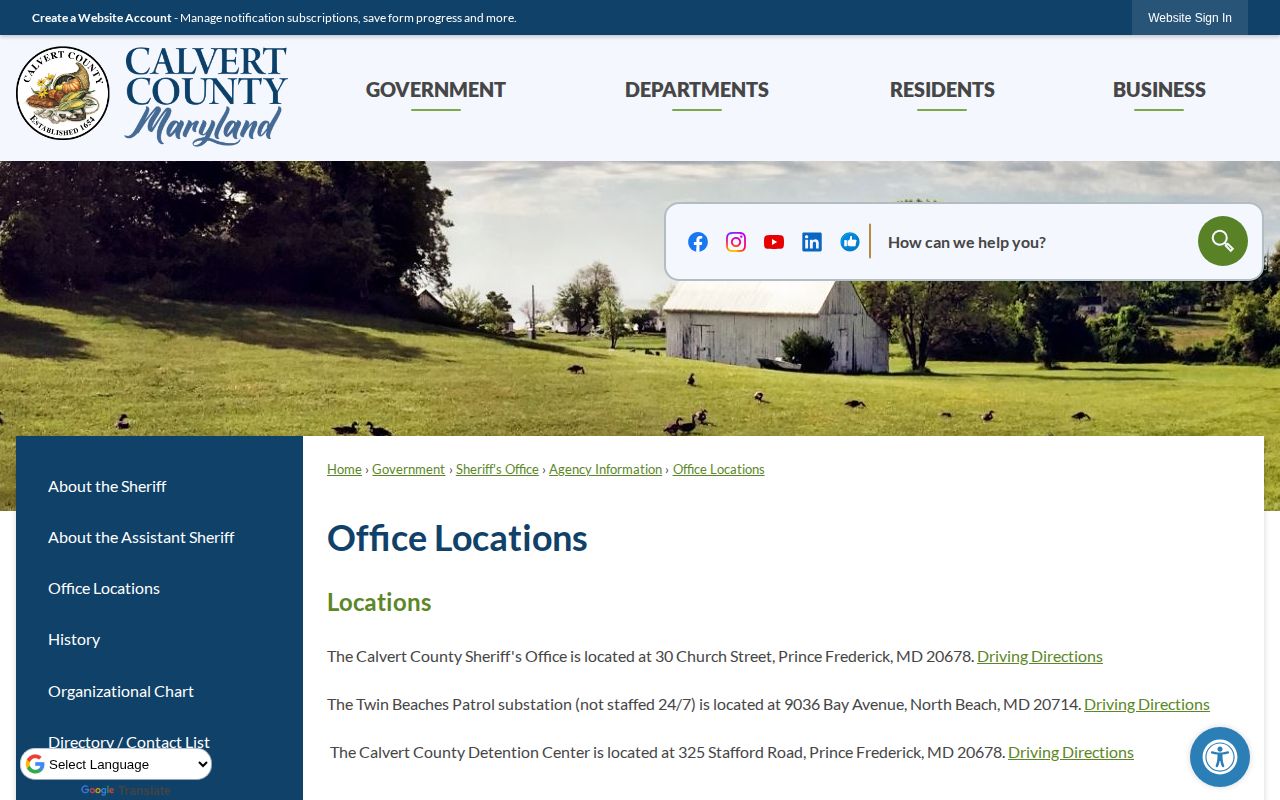
It anchors the three-day records workflow in the county’s official detention and Sheriff channels rather than an unofficial release feed.
For a court record, contact the clerk that owns the case. For a state-prison record, use DPSCS. Federal prison, U.S. Marshals, and ICE matters remain separate. Sending a request to the right owner reduces the risk that one office is asked to interpret another agency’s data.
Compare Calvert County Release Results
A three-day list can mix outcomes if release types are not preserved. Bond or recognizance usually means the person left secure custody while the case continued. Time served or sentence satisfied relates to a sentence calculation. Supervised pretrial release, home detention, and work release involve community placement with controls. A transfer closes the CCDC booking while custody continues elsewhere.
| Record result | Safe conclusion | Follow-up source |
|---|---|---|
| CCDC release sheet gives gate time and bond | Released from CCDC on the recorded bond event | Court bond order and current case |
| Court orders supervised pretrial release | Authorized for program placement, subject to actual processing | CCDC exit and Community Supervision Unit |
| CCDC records a DOC transfer | Local booking ended; state custody continued | DPSCS locator after intake and commitment record |
| VINE reports release from CCDC | Source agency reported the named release event | CCDC sheet for exact authority and time |
| No result in DPSCS locator | Not found in that current-custody tool | VINE, court, DPP or MPC, and DPSCS records |
For a same-day slice, use the Calvert County 24-hour release process. When the goal is one named person rather than everyone in a window, use the full Calvert County released inmate lookup so local, state, federal, court, and supervision records are not mixed.
Document Calvert County Three-Day Releases
A clean result names the record and stays within its scope. Write “CCDC recorded release on [date and time] by [type]” when the release sheet supplies those facts. Write “CCDC recorded transfer to [agency]” when custody continued. If only VINE supplies the event, name VINE, the contributing agency, and the timestamp instead of broadening the claim.
Conflicts can reflect different events. A judge’s release order and the jail’s physical gate time may be hours apart. A VINE alert can arrive after the movement it reports. A court entry may be posted after a weekend. Preserve each source’s time and ask the office that created the disputed record to correct it. Never resolve similar names by guesswork.
The three-day method is slower than reading a feed because Calvert County provides no such public feed. It is also more precise. An exact window, an existing agency record, and a second source create a result that can be understood after the rolling period has passed.