
Maryland DOC Release Paths
A person sentenced in Calvert County to the Commissioner of Correction can be assigned to a Division of Correction institution elsewhere in Maryland. Classification and transport decisions are statewide. No official source reviewed identifies a state prison inside Calvert County, so there is no factual basis for naming a “Calvert DOC prison” or assuming the nearest institution holds the person.
State release can occur through maximum expiration, parole, or mandatory supervision. Parole is a discretionary conditional release ordered through the Maryland Parole Commission. Mandatory supervision is a conditional release that results when applicable diminution credits equal the term remaining, subject to statutory rules. Maximum expiration marks the sentence endpoint. A transfer between prisons, to local custody, or to another sovereign is not release into the community.
| DOC event | Where to confirm it |
|---|---|
| Current state custody | DPSCS Incarcerated Individual Locator, with its published coverage limits. |
| Parole approval | Maryland Parole Commission decision or notice, followed by proof that prerelease conditions were met. |
| Actual state release | VINE event, DOC release record, sentencing docket, or disclosable supervision record. |
| Sentence discharge | DPSCS discharge or maximum-expiration record from the agency that owns the calculation. |
| Transfer | Sending and receiving agency records; do not label it community release. |
The precise state event matters because parole and mandatory supervision continue the sentence under conditions. They are not unconditional discharge. The actual release date may follow a decision or eligibility date after administrative processing.
Confirm a Maryland DOC Release
The DPSCS Incarcerated Individual Locator searches first and last name and identifies the current facility for covered people. DPSCS expressly says people no longer in custody for any reason, including release or escape, are not listed. The locator also omits some people within the broader system. Treat “not found” as an unresolved current-custody search, not proof of release.
- Search the DPSCS locator and save the exact response and query time. Compare full identity and spelling.
- Search the same person in Maryland VINE. Read the source agency, custody label, event date, and update time.
- Inspect the Calvert sentencing case for the commitment, sentence, later orders, and supervision terms. The court summary is not the full file.
- Determine whether a parole decision or mandatory-supervision record applies. Approval or eligibility is not the gate date.
- Request the release, discharge, or sentence-calculation record from DPSCS when an affirmative official date is needed.
The Calvert County released inmate search covers the local CCDC route as well. That local path is not interchangeable with a DOC discharge search. A person can leave CCDC through transfer to the Commissioner of Correction and remain confined after the local booking ends.
Maryland DOC Release Records
DPSCS is the correct custodian for state correctional release and sentence-calculation records. It does not hold local CCDC or court records merely because the underlying case began in Calvert County. Send the DOC request to DPSCS, the jail request to Calvert County, and the signed-order request to the court clerk.
Maryland Department of Public Safety and Correctional Services
6776 Reisterstown Road
Baltimore, MD 21215
410-585-3300
877-379-8636
DPSCS Public Information Act requests
dpscs.pia@maryland.gov
Ask for the final release or discharge record, release date and legal authority, and the sentence-calculation sheet or maximum-expiration and mandatory-release calculation when relevant. A former prisoner’s full institutional case file is not automatically open. Correctional, security, medical, investigatory, and personal-information limits may require withholding or redaction.
Former DPSCS detainees seeking their own base or medical file are directed by the agency to the releasing institution or the Case Management Office for Operations. A narrow request improves the chance that disclosable portions can be separated. Ask the custodian to cite the legal basis for each withheld item.
Maryland DOC Locator Fields
The state locator has a much narrower public field set than readers may expect. Its search inputs are first and last name. Results concern covered people who are currently housed and identify a location. The reviewed public locator does not expose a historic release status, discharge date, current parole office, release certificate, or projected release date.
| First name | Public search input; use the legal spelling and test known variants carefully. |
|---|---|
| Last name | Public search input required to identify a possible current match. |
| Current location | May appear for a covered person housed in the state system. |
| Released status | Not retained as a public profile because former prisoners are removed. |
| Projected date | Not shown in the reviewed public locator. |
| Supervision status | Not supplied as a public locator field for a former prisoner. |
A result’s absence has many possible causes: release, escape, spelling mismatch, timing, a coverage exclusion, or movement outside the displayed population. The source that supplies an affirmative dated release event must be named in any conclusion. The manifest image below comes from the official DPSCS locator explanation.
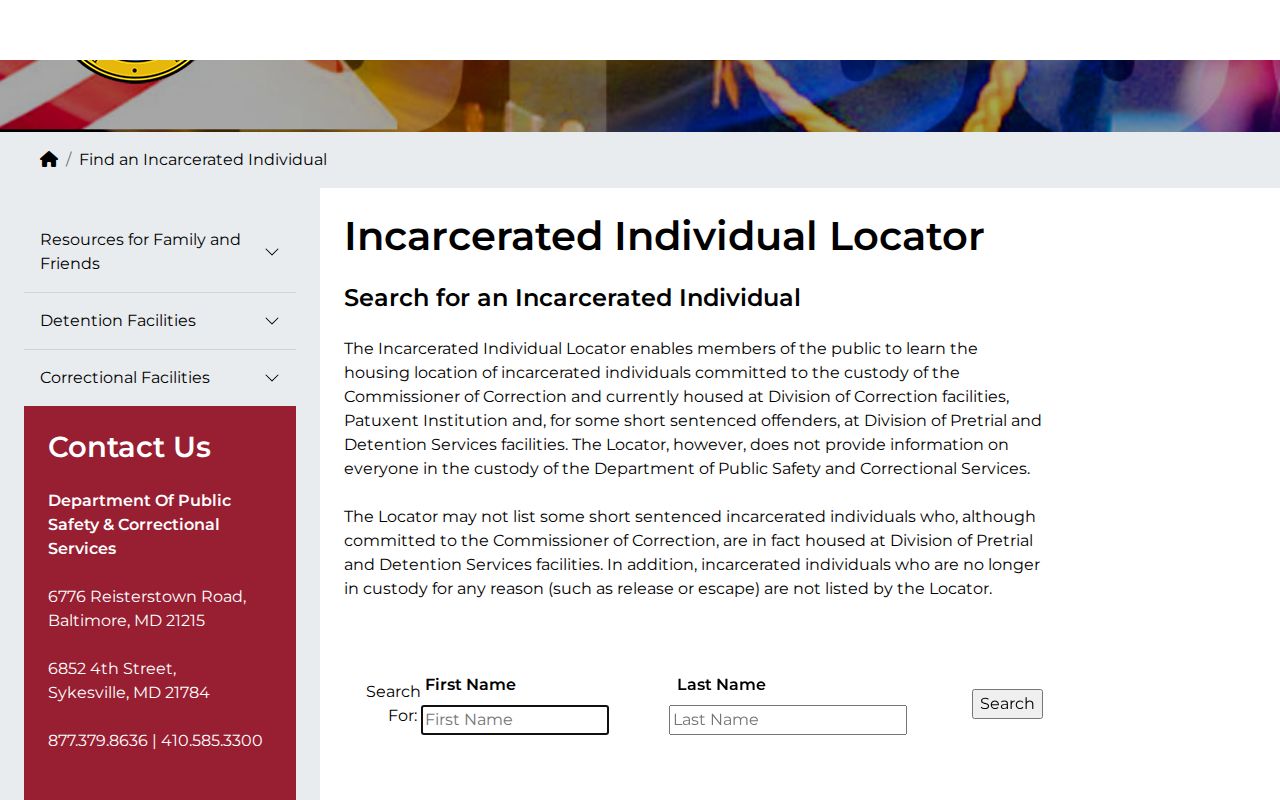
Its current-custody warning supports the need for VINE, court, supervision, or DPSCS release records when a former prisoner disappears.
Note: The locator’s first-name and last-name inputs find possible current matches, not a retained Maryland DOC release history.
Maryland DOC Release Calculations
Maryland does not use one universal percentage for every state sentence. Correctional Services §3-704 generally provides good-conduct credit at ten days per calendar month, prorated for a partial month. A five-day rate applies when the term includes a concurrent or consecutive sentence for a statutory crime of violence or specified drug offense. The offense, offense date, sentence structure, exclusions, and later events all matter.
Other provisions address work tasks, education, educational milestones, and special programs. Section 3-708 limits combined credits and includes category restrictions. Credits can also be revoked. An estimate that assumes every available category at the highest rate can be wrong because assignment, achievement, eligibility, caps, and loss must be documented.
Mandatory supervision under §7-501 can apply when awarded diminution credits cover the term remaining for an eligible sentence. The release carries conditions. Parole eligibility under §7-301 is a different calculation and only opens the possibility of consideration. Neither date proves the person actually left a DOC facility.
Note: Request the official state calculation instead of combining sentence and credit rules without the complete record.
Maryland DOC Parole Release
The Maryland Parole Commission decides suitability for qualifying people. Its common outcomes include refusing parole, scheduling a future rehearing, or approving parole release. An approval can still depend on an acceptable home plan, administrative processing, the absence of a controlling detainer, and other prerelease conditions. Decision date, projected release, and actual exit are separate facts.
After actual release, the Division of Parole and Probation administers community supervision. The Prince Frederick Field Office is the local administrative contact when a court, VINE, or parole record indicates Maryland supervision for a Calvert County person. It is not a public name-search portal. Staff may limit what they disclose.
- Eligibility
- The first legal point at which parole consideration may be possible, not a release promise.
- Approval
- A favorable decision that can remain subject to a plan, hold, or processing step.
- Parole
- Conditional service of the rest of a sentence in the community.
- Discharge
- The lawful end of the relevant correctional or supervision authority.
A later violation can lead to a warrant, hearing, revocation, and reincarceration. Date every status statement and use the official record that owns the event.
Calvert Cases Entering Maryland DOC
A Calvert County defendant may remain at CCDC for a period after commitment while transfer is arranged. The local record can show departure to the Commissioner of Correction. The state locator becomes useful only after the person is received and visible in a covered institution. A lag between those systems is possible.
Likewise, release from DOC does not erase the Calvert court case. Maryland Case Search may preserve the sentence and docket events long after the state locator stops showing the person. Some records can be removed from remote display for legal reasons, and the web docket remains only a summary. Obtain the full file from the Calvert court clerk when the signed commitment or later order controls.
If an immediate detainer transfers the person to local, federal, or immigration custody, the DOC exit is not a return to the community. The receiving agency owns the next custody record. VINE repeats participating agency data and is useful for notifications, but the originating release record resolves a disputed time or reason. A reliable Maryland Division of Correction release finding therefore states which system ended custody, what dated record proves it, and whether parole, mandatory supervision, another hold, or a new custody event followed. When records conflict, prefer the dated document from the office that owns the disputed fact. The court owns its sentence and orders, DPSCS owns state custody and calculations, the Parole Commission owns its decision, and the Division of Parole and Probation owns supervision administration. Preserve both the event time and the later query time.
Note: A Calvert County commitment begins a state custody path, but only the receiving and releasing records show the later DOC events.