
Calvert Detention Center Release Paths
Calvert County Detention Center, often shortened to CCDC, is the local adult detention center. It holds people before trial, people serving qualifying local sentences, and people waiting for a court decision or transfer. Physical departure from the building does not always mean release into the community. The controlling event may be a bond, own-recognizance order, supervised pretrial placement, time-served calculation, sentence expiration, home detention placement, or transfer. Each label answers a different question about what happened next.
A court-ordered bond or recognizance release generally returns the person to the community while the case continues. A local sentence may end after the maximum term and valid credits are applied. By contrast, a transfer to the Maryland Division of Correction, another county, federal authorities, a hospital, or a treatment placement means custody or control continues elsewhere. A detainer is a request or legal hold that can keep a person from leaving freely after the Calvert matter changes.
The Calvert County Detention Center release entry is the best source for the actual local exit and its authority. The court owns the signed bond, release, commitment, and sentence orders. Maryland VINE can report a custody change supplied by a participating agency. When those sources differ, compare the event time with the time each system was checked.
Confirm a CCDC Release
There is no official online CCDC roster or released-person archive in the county channels reviewed in July 2026. That makes a blank web search meaningless. Use a person-specific check and then obtain the record owned by the office that handled the event. The broader Calvert County released inmate search explains the same custody-system choice for local, state, and federal cases.
- Collect the person’s full legal name, spelling variants, approximate birth information, booking number if known, arrest date, and Calvert court case number.
- Search Maryland VINE. Match the person, source agency, event date, custody label, and last-update time before treating a result as relevant.
- Search the Maryland Case Search and Record Portal for both District and Circuit Court matters. Read bond, disposition, sentence, probation, warrant, and event entries in context.
- Call CCDC for present operational information. Ask whether the person remains housed there and which public channel can document the exit if the person is no longer present.
- Request the existing booking and release sheet through the Calvert County Public Information Act portal when documentary proof is needed.
A VINE release event confirms only the event reported by its source agency. It does not rule out a transfer, new booking, or another hold. Case Search is also a summary. The jail’s dated release entry and signed court order resolve different facts, so keep both when the precise authority and gate time matter.
Note: Record the agency, event date, and query time because custody status can change after any saved result.
CCDC Release Records and Contact
The detention center is the right first office for current local custody and the local booking or release record. Staff may limit person-specific details by phone. A focused written request is the better route when the date, time, authority, type, or transfer destination must be documented. Ask for an existing record instead of asking staff to create a new report or answer a broad question.
Calvert County Detention Center
325 Stafford Road
Barstow, MD 20610
Mailing: P.O. Box 9
410-535-4300
Alternate: 301-855-9640
Fax: 410-535-4537
Operations: 24 hours
A useful request names the person and date of birth if known, booking number, approximate booking and release dates, and CCDC as the facility. Ask for the booking/release sheet, admission and release time, release authority and type, destination category or receiving agency if disclosable, and any related booking photograph needed to identify the record. If a field is withheld, ask for the nonexempt, segregable remainder and the legal basis for withholding.
The Sheriff Records Unit lists fees for certain report products, but those figures are not a guaranteed price for a jail release sheet. Request a cost estimate before chargeable work. The Sheriff’s NextRequest portal accepts Maryland Public Information Act submissions to the agency custodian.
Note: CCDC owns the local gate record, while the court owns the signed order that authorized the release or transfer.
CCDC Release Record Fields
Calvert County does not expose the CCDC jail-management screen, so the following items are request targets rather than claims about a public display. No single universal “release record” exists. The available fields depend on the booking, court authority, transfer, and lawful access limits.
| Requested field | What it can establish |
|---|---|
| Booking identity and number | Links the release entry to the correct local admission. |
| Admission date and time | Marks when CCDC recorded the custody period. |
| Release date and time | Records the operational exit from CCDC. |
| Release authority or type | Distinguishes bond, court order, sentence completion, supervised placement, or another basis. |
| Transfer agency or category | Shows whether custody continued with another system, if that information is disclosable. |
| Court and bond data | Connects the jail action with the legal order or pending case. |
“Time served” and “sentence satisfied” concern a sentence calculation. “Parole” and “mandatory supervision” are conditional forms of community release. “Probation” is imposed by a court and does not itself prove a prison term. “Transfer” means the person left CCDC but remained in custody elsewhere. Keep the precise term shown in the record.
Calvert Release Orders and Transfers
A Calvert criminal matter may appear in District Court or Circuit Court, and a case can move between them. The online case summary may show a bond review, release conditions, disposition, sentence, commitment, probation, or warrant event. It may not show the exact time the jail completed processing. A judge’s order at one time and a later CCDC gate entry can both be correct.
The Circuit Court for Calvert County and the District Court clerk maintain their own files. Ask the correct clerk for a signed order, commitment, sentencing sheet, or full docket when the web summary is unclear. Some favorable outcomes are removed from remote display while records may remain available at the courthouse. Sealed, shielded, expunged, juvenile, and other restricted records will not be publicly available.
If the person was committed to the Commissioner of Correction, CCDC may hold that person before state intake. The Maryland DPSCS locator can become useful only after receipt into a covered state facility. It is a current-custody tool and removes people who are no longer in custody, so a missing name never confirms a state release. Federal and immigration transfers require their own systems.
Note: A transfer entry proves departure from CCDC, but it does not prove release into the Calvert County community.
CCDC Supervised Release Programs
Calvert’s supervised Pre-Trial Release Program explains why someone may be outside secure detention while the criminal case remains active. Entry requires court authorization or a judge’s order. Supervision may include electronic monitoring and tailored treatment. A court order and the CCDC Community Supervision Unit are the authoritative ways to distinguish program placement from an unrestricted return to the community.
- Pretrial release
- A court-authorized departure from secure detention while charges remain unresolved.
- Home detention
- A court-approved way for an eligible sentenced person to serve time at home under monitoring.
- Work release
- A structured community-custody program that permits approved activity outside secure detention.
- Discharge
- Completion of the relevant custody or supervision authority, not merely leaving the jail building.
Use the exact program name in any status statement. “Released from secure detention to home detention” is more accurate than “discharged” when rules and monitoring continue. Program staff can share only what the law allows. The court docket may supply the most accessible public proof of the placement order.
Calvert Detention Center Release History
The official CCDC history places the modern local release system in context. The Barstow jail opened on September 5, 1978, with six work-release and twenty maximum-security inmates. It was built for a rated capacity of 92. An expansion followed in 1992, when the rated capacity became 172 and the facility adopted the Calvert County Detention Center name.
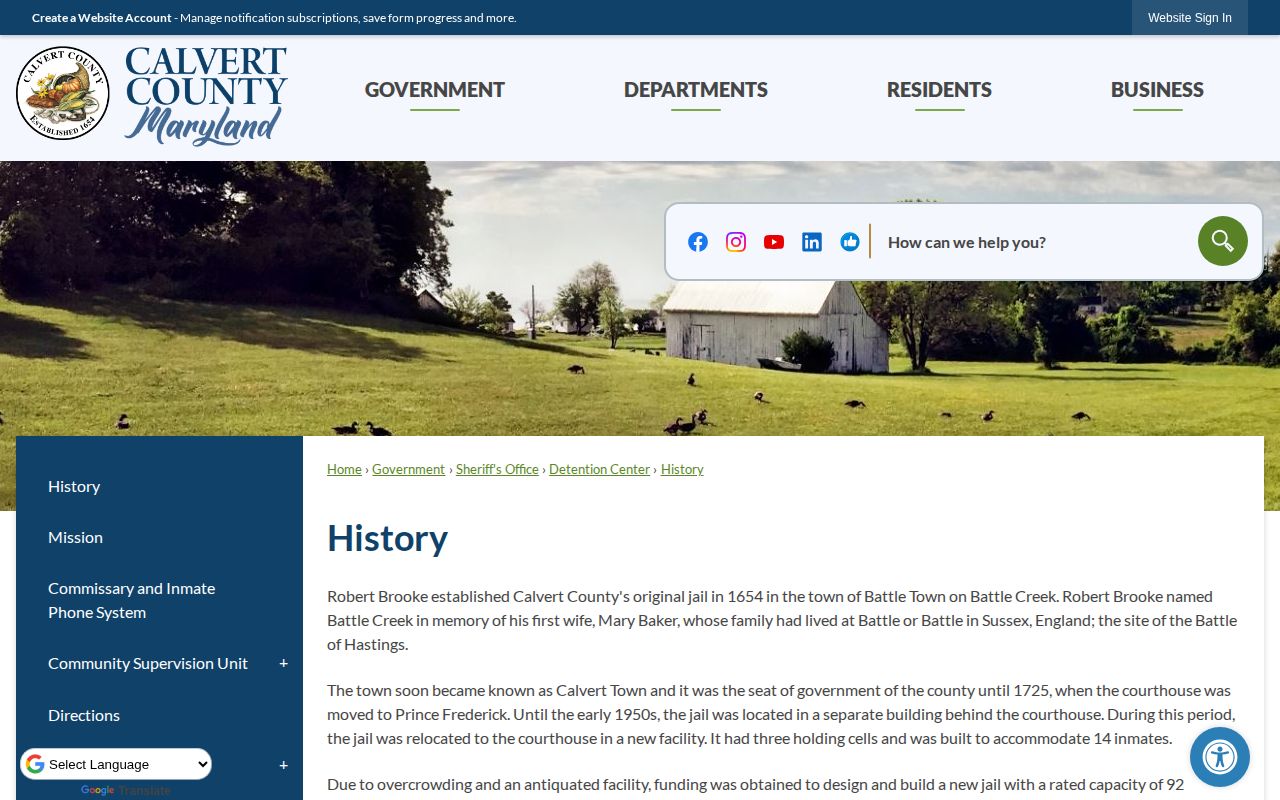
Those numbers are historical markers, not a current bed count. They do show that community-custody programming has been part of the Barstow operation since its opening. Current status still depends on a dated CCDC record, a court order, or the receiving agency rather than an old capacity figure.
The distinction also keeps local and state systems separate. CCDC is operated by the Calvert County Sheriff’s Office Corrections Bureau. It is not a Maryland state prison. A person serving a local term follows the local record and credit framework, while a person transferred to the Division of Correction enters a statewide system.
CCDC Property Release Rules
CCDC publishes a limited rule for property pickup while someone is incarcerated. The incarcerated person must submit a request to release property. Property is released from 8 a.m. to 4 p.m. Monday through Friday and not during visitation. This rule helps a family member plan a permitted pickup, but it does not document what happens to property during a person’s final exit.
Confirm final-release property procedures directly with CCDC before traveling. Do not assume the published third-party pickup schedule controls the gate process. The same caution applies to transportation. A community release, court trip, program placement, and agency transfer can use different exits and arrangements.
Does property pickup prove release? No. A person can authorize property release while still confined. Treat the property request and the custody event as separate records.
For a reliable Calvert County Detention Center release conclusion, name the source agency, event, date, and time checked. If the purpose is to learn where the person went, request the transfer agency or destination category when disclosable. If identity is uncertain, stop at “not confirmed” rather than matching by name alone.